An unsecured loan is money you borrow from a bank or NBFC without pledging any asset as security. There is no house, gold, or vehicle backing it. The lender approves you mainly on your income, repayment history, and credit score.
Personal loans and credit cards are the most common examples. Because there is no collateral, approval leans heavily on your creditworthiness.
How Do Unsecured Loans Work?
With an unsecured loan, the lender relies on a promise to repay rather than a pledged asset. Your application is judged on income stability, existing debts, and your credit score. If you meet the criteria, the money is disbursed, and you repay it in fixed monthly EMIs.

Since nothing is pledged, these are also called collateral-free loans, and the lender carries more risk than in a secured loan. That risk is priced into the interest rate.
This risk is not just a theory. In November 2023, the RBI raised the risk weight on unsecured consumer credit, including personal loans, from 100% to 125%, which pushed lenders to set aside more capital. This matters to you because higher lender costs usually show up as higher borrowing rates.
Here is the basic flow:
- Apply with your income and identity documents.
- Verification of income, employment, and credit history.
- Approval based on your credit profile, not an asset.
- Disbursement to your bank account, often within a day or two.
- Repayment in equal monthly EMIs over a fixed tenure.
Types of Unsecured Loans
Unsecured credit comes in several forms, each suited to a different need. Knowing the type helps you pick the cheapest tool for the job.
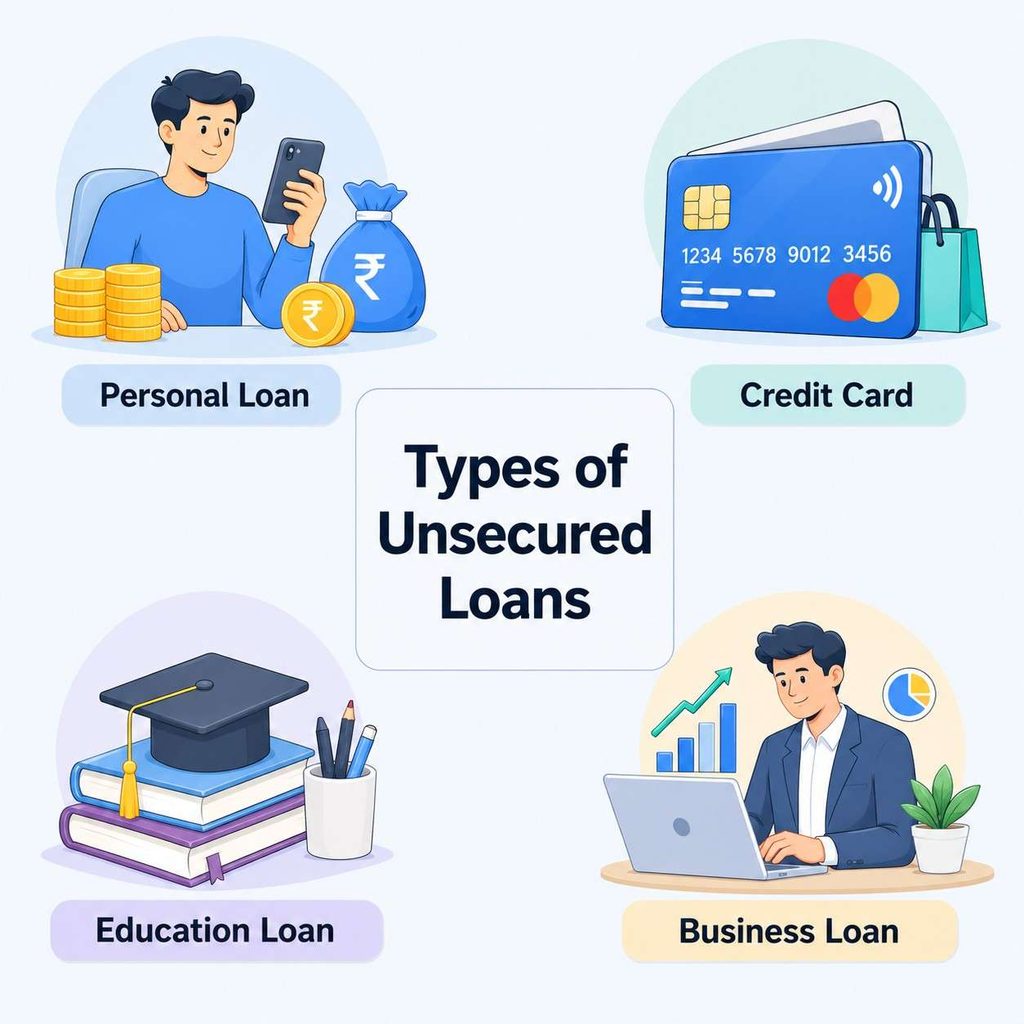
- Personal loan: A lump sum for weddings, travel, medical bills, or debt consolidation.
- Credit card: A revolving limit you can reuse, usually the costliest form of unsecured credit if not paid in full.
- Consumer durable loan: Short-term finance for phones, appliances, or electronics.
- Education loan (unsecured portion): Smaller amounts often given without collateral.
- Business loan (unsecured): Working capital for small businesses based on turnover.
- Overdraft or line of credit: A pre-approved limit you draw from as needed.
The share of these loans has grown sharply. Unsecured advances rose to 25.3% of total credit disbursed by scheduled commercial banks by March 2024, up from around 18% in March 2016. This tells you how mainstream this product has become for Indian borrowers.
Secured vs Unsecured Loan: What Is the Difference?
The core difference is collateral. A secured loan is backed by an asset the lender can claim on default. An unsecured loan is not, so the lender depends on your credit standing.
| Feature | Secured Loan | Unsecured Loan |
|---|---|---|
| Collateral | Usually required | Not required |
| Lender’s risk | Generally lower | Generally higher |
| Approval | May depend on asset and borrower | More dependent on creditworthiness |
| Interest rate | Often lower (home loans from about 7.35% p.a.) | Often higher (personal loans commonly 10% to 24% p.a.) |
| Common examples | Home loan, vehicle loan, gold loan | Personal loan, credit card |
The interest gap is real. Home loan rates from public banks started around 7.35% p.a., while personal loan rates commonly run from about 10% up to 24% p.a.
If you already own an asset, a secured route can be far cheaper. For instance, understanding how a gold loan works shows how pledging gold can unlock lower rates than an unsecured personal loan for the same amount.
How to Apply for an Unsecured Loan
The process is fast and mostly digital. Preparing your documents first avoids delays and rejections.
1. Check your credit score before applying to know where you stand.

2. Compare lenders on interest rate, processing fee, and tenure.
3. Read the Key Facts Statement. Since October 1, 2024, the RBI requires every retail term loan to come with a Key Facts Statement showing the all-inclusive Annual Percentage Rate (APR). This lets you compare the true cost, not just the headline rate.
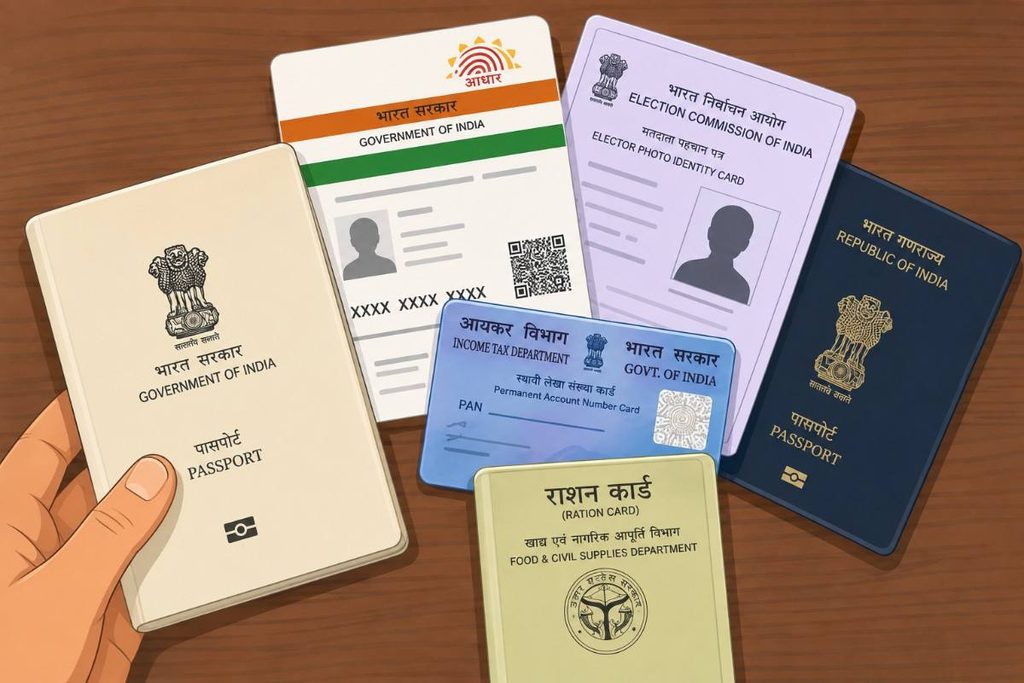
4. Submit documents such as PAN, Aadhaar, salary slips, and bank statements.
5. Complete verification and accept the sanction terms.
6. Receive disbursal in your account.
A quick tip: apply to one or two lenders you are likely to qualify for. Multiple applications in a short span trigger several hard enquiries, which can dent your score.
Eligibility Criteria for an Unsecured Loan
Lenders set their own rules, but the common checks are similar across banks and NBFCs. Meeting them improves both approval odds and your rate.
- Age: Usually 21 to 60 years.
- Income: A stable monthly income above the lender’s minimum.
- Employment: Salaried or self-employed with a steady track record.
- Credit score: A healthy score, ideally 750 or above.
- Existing debts: Room in your budget after current EMIs.
That last point deserves attention. Lenders look at how much of your income already goes to EMIs before offering more.
Reviewing how to check active loans in your name helps you spot obligations that could reduce your eligibility or even flag errors before a lender sees them.
Does Credit Score Matter for an Unsecured Loan?
Yes, more than for any other loan type. With no asset to fall back on, your score is the lender’s main signal of risk. CIBIL scores range from 300 to 900, and a score of 750 or above is widely preferred, though some lenders consider applicants with scores around 650.
A better score does more than get you approved. It often earns a lower interest rate and a higher sanctioned amount, which can save you thousands over the tenure.
Check your score before you apply. You are entitled to one free full credit report from each credit bureau every calendar year under RBI rules, and checking your own score is a soft enquiry that does not lower it.
How Much Can You Borrow With an Unsecured Loan?
There is no single cap. Your limit is shaped by your income, credit score, existing EMIs, and the lender’s policy. Because there is no collateral to fix the amount, lenders size the loan to what they believe you can comfortably repay.
The key restraint is your repayment capacity. Lenders keep your total EMIs within a manageable share of your monthly income so you are not overstretched. A higher income and a clean credit record widen the ceiling, while heavy existing debt shrinks it.
Example: On a ₹5 lakh personal loan at 12% p.a. for 5 years, your EMI works out to roughly ₹11,122. Over the full tenure, you would repay about ₹6.67 lakh, meaning around ₹1.67 lakh in interest. Seeing the total cost, not just the EMI, helps you borrow only what you truly need.
When Should You Consider an Unsecured Loan?
An unsecured loan fits when you need funds quickly and have no asset to pledge, or do not want to risk one. It is best for short-term, planned needs you can repay comfortably.

Good use cases include:
- Medical emergencies that cannot wait.
- Debt consolidation to replace costlier credit card dues with one lower EMI.
- Weddings or home renovation with a clear repayment plan.
- Education or skill courses that boost future earnings.
It is a poor choice for routine lifestyle spending or to cover an EMI you already cannot afford. Borrowing for wants rather than needs is how debt spirals begin.
What Is the Interest Rate on an Unsecured Loan?
Unsecured loans carry higher rates than secured ones because the lender has no asset to recover. Personal loan rates from major banks currently start near 10% p.a. and can rise to around 24% p.a. depending on your profile.
A snapshot of starting rates from leading lenders shows how they vary:
| Lender | Personal loan rate (p.a.) |
|---|---|
| HDFC Bank | 10.50% onwards |
| Axis Bank | 10.49% onwards |
| ICICI Bank | 10.65% onwards |
| State Bank of India | 11.15% to 15.30% |
| Bank of Baroda | 11.05% to 18.75% |
These indicative rates are drawn from a bank-by-bank comparison. Your actual rate depends on your credit score, income, and lender.
Interest is not the only cost. Watch for:
- Processing fee: Typically 0% to 3% of the loan amount, plus 18% GST.
- Prepayment or foreclosure charges: Vary by lender and loan type.
- Late payment penalties: Charged on missed EMIs.
On prepayment, a recent rule helps some borrowers. Under the RBI Pre-payment Charges on Loans Directions, 2025, lenders cannot levy prepayment charges on floating-rate loans taken by individuals for non-business purposes, sanctioned or renewed on or after January 1, 2026. Note that most personal loans are fixed-rate, so check your rate type before assuming you qualify.
Benefits of an Unsecured Loan
The appeal of these loans is speed and simplicity. For the right borrower, they solve a cash need without tying up assets.
- No collateral: Your home, gold, or car stays untouched.
- Fast approval: Disbursal is often within a day or two for a strong profile.
- Flexible use: Funds can go toward almost any personal need.
- Minimal paperwork: Fewer documents than a secured loan.
- Fixed EMIs: Predictable repayment that is easy to budget.
Disadvantages and Risks of Unsecured Loans
The convenience comes at a price, and the risks are worth respecting. Understanding them prevents costly mistakes.
- Higher interest rates: You pay more than on a secured loan.
- Strict eligibility: A weak credit score can mean rejection or steep rates.
- Lower amounts: Limits are usually smaller than asset-backed loans.
- Credit damage on default: Missed EMIs hurt your score for years.
- Legal recovery: No collateral does not mean no consequence. Lenders can still pursue recovery and report defaults to credit bureaus.
The credit score risk is the quiet one. A default can stay on your record for years, making future borrowing harder and costlier long after the loan itself is settled.
Conclusion: An Unsecured Loan is Borrowing that Needs No Collateral
Unsecured loans give you quick, asset-free access to funds, which makes them useful for emergencies, consolidation, and planned needs. The trade-off is a higher interest rate and heavy reliance on your credit score.
Before you borrow, check your score, compare the all-inclusive APR across lenders, and confirm the EMI fits your budget. Used carefully for genuine needs, an unsecured loan is a practical tool rather than a debt trap.
FAQs
Yes. A credit card is a revolving form of unsecured credit. It needs no collateral, but it usually carries higher interest than a personal loan if you do not clear the full balance each month.
It is harder, since lenders rely on your score. Some NBFCs assess new-to-credit borrowers using alternative data, but expect stricter terms or higher rates until you build a record.
Each application triggers a hard enquiry that can nudge your score down slightly. Checking your own score, however, is a soft enquiry and does not affect it.
It depends on your rate type. From January 1, 2026, the RBI bars prepayment charges on floating-rate loans to individuals for non-business use. Most personal loans are fixed-rate, so check your agreement.
For a strong credit profile and complete documents, many banks and NBFCs disburse within 24 to 72 hours, and some offer near-instant approval for pre-approved customers.